x
Passengers
Business
Workforce

Main navigation

  • Flights
    • Book a Trip
    • Arrivals
    • Departures
    • Flight Tracker
  • Parking + Transportation
    • Parking
    • Rental Cars
    • Ground Transportation
  • Passenger Services
    • In the Terminal
    • Safety + Operations
    • Special Needs
    • Passenger Appreciation
  • FAQs
    • About the Airport
    • Flights + Airlines
    • Passenger Services
    • Travel Tips
    • Security
  • News + Statistics
    • News
    • Statistics
    • Media
    • News Archives
  • Community Connection
    • Art + Music in the Airport
    • Honoring Western North Carolina Pilots
    • Make a Suggestion
  • General Aviation
    • General Info
    • Directions
    • Maintenance + Sales
    • Fixed-Base Operator
    • Learn to Fly
    • For Pilots
  • Sign Up — Window Seat E-newsletter
  • Contact Us

Business Menu

  • Airport Authority
    • Annual Report
    • Rules + Regulations
    • History
    • Tenants
    • Ordinances
    • Staff
    • Career Opportunities
  • Doing Business with AVL
    • Advertising
    • Filming on Site
    • DBE/ACDBE Programs
    • RFP-RFQ-RFB
    • AVL Minimum Standards
    • Airport Development Guidelines
  • Planning + Development
    • 2013 MASTER PLAN DOCUMENTS
    • CURRENT MASTER PLAN PROCESS
  • Board
    • Board Documents
    • Board Schedule + Legal Notices
    • Action Agenda
    • Board Agenda
    • Budget
    • Meeting Minutes

Workforce Menu

  • AVL KIND
X        
mobile navbar button
Home

Breadcrumb

  1. Home
  2. News + Statistics
  3. News Archives
Historic Plane

News Archives

See below for a comprehensive collection of past news and updates.

Swoosh

From Legacy to Low Cost: How Different Types of Airlines Work

January 27, 2016

Do you ever wonder why some airlines' tickets cost so much less than others, or why some charge more for baggage and seat selection? Every business in every industry is a little different than its competitors and airlines are no exception. Within aviation, airlines are generally grouped into three categories: legacy (or “network”) airlines, low cost carriers (LCCs), and ultra low cost carriers (ULCCs). While no two airlines are exactly alike, almost all of them fall into one of these categories.

Ultra low cost airlines like Allegiant, Spirit and  Frontier have the goal of offering the lowest ticket price possible. Their tickets can be described as “no frills” and things like bags, seat selection, and onboard food and drinks generally cost extra. They are extremely cost-responsible in their operations and management, which allows them to offer the lowest airfares. By not including the cost of a bag, snacks, drinks, in-flight entertainment, and other amenities in the ticket price, these airlines can often offer extremely low fares and high value. ULCC’s generally cater to people going on vacation or enjoying other forms of leisure travel, but each one does so differently. Frontier and Spirit almost exclusively fly between very large markets, with at least one roundtrip flight per day, and they don’t mind adding routes that other airlines already fly. Allegiant’s core model is to fly from small- or mid-sized communities (just like us) to very popular leisure destinations a few times per week. Many consider this a relatively new airline business model, but it’s more or less a refining of the low cost carrier model that some airlines have been using since the 1970s.

When we say “low cost carrier” the first airline that pops into your mind could very well be Southwest Airlines, as they’ve been flying since 1971 and touting low fares and friendly service as they’ve grown into the nation’s largest domestic airline in terms of the number of passengers carried. These days, however, the LCC category has become a bit less defined than it once was. The term actually has more to do with an airline’s operating costs than with its ticket prices, which are simply a result of the low operating costs. Frontier and Spirit were once LCCs but transitioned to become ULCCs. Other airlines in this category like JetBlue and Virgin America are regarded as low cost carriers by some and not by others. Some would say that the traditional LCC’s like Southwest and JetBlue have slowly transformed into carriers whose fares aren’t always “low” but are never “high” and include some amenities in their ticket price. As these airlines have matured, they’ve grown into having large networks with far more connecting traffic and have added passenger comforts like in-flight entertainment, which raises the cost to operate.

Last but not least, the network airlines are the mega-brands that have been around in one form or another since the dawn of commercial aviation. American, Delta, and United are the three U.S. network airlines. These are the most “evolved” airlines and have global route networks, huge hubs, huge fleets and multiple types of aircraft. With aircraft ranging from 50 to nearly 400 seats, network airlines can get you from Asheville to Shanghai, often in just one stop. They carry a wide array of passengers, including leisure and business passengers traveling domestically or internationally.  They have sophisticated products that cater to business and international travelers. First-class cabins, club lounges, in-flight entertainment and Wi-Fi have become core products for this group of airlines. They’ll happily connect you to Florida for vacation, as well as London or Boston on a last-minute business venture.

As the industry and the consumer both continue to evolve, so do the airlines. Throughout history, airlines of all types and sizes have come, grown, evolved, changed and gone. Once mighty legacy airlines like Pan Am have gone under and others like Piedmont have become part of the lineage of today’s airlines through mergers. The only constant is that regardless of your budget and destination, there will almost always be an airline built to cater to you.

 

A runway is important to Western North Carolina! Take a journey with us to learn why.

December 17, 2015

They say a mile of highway will take you a mile but a mile of runway will take you anywhere. When your plane takes the runway at Asheville Regional Airport, takeoff thrust is applied and after approximately one mile of acceleration, you gracefully begin to soar airborne. You didn’t just depart for Atlanta, Charlotte, Florida, New York or Chicago. You just entered the vast, global air transportation network. You could be headed to the other side of the state or the other end of the globe.

At a glance, a runway may appear to only be pavement with different colored lights and paint, but a runway is the greatest gateway to the world a community can possess, and a massive economic engine as well (to the tune of half a billion dollars in this case). At AVL, our runway allows our community to do business all over the world. It allows residents of Asheville and western North Carolina to easily venture to any point on the planet they please. Like a highway, a runway is also omnidirectional, both physically and figuratively. That same runway that lets you jet off to London for business or glide into Palm Beach for vacation also allows business travelers and visitors from far away places to come to our community. It lets them invest in our region — our families, businesses and quality of life — by bringing their own business here, visiting WNC to shop or sight-see and to experience this amazing region we call home.

It’s for all of these reasons that the runway at AVL is worthy of our care and attention. Right now, we’re in the third of four construction phases that will result in a brand new runway, which translates to new opportunities for WNC. Starting this month and continuing over the next year, you’ll be able to see the construction of the new runway here at AVL as your flights take off and land on a temporary runway that is serving as a literal stepping stone to the future.

Near the end of 2017, you will board a jet at Asheville Regional Airport. When your plane crosses the threshold of the runway and takeoff thrust is applied, you will accelerate down the smooth pavement, passing lights and runway markers, knowing that this mile of runway is taking our community higher and is giving you the power to go anywhere.

Please take a moment to learn more about our important runway project, titled "Project SOAR."

Of The Essence: Local artists exhibiting in airport art gallery

November 20, 2015

(Asheville, N.C.) Of The Essence, the newest Art in the Airport exhibit at Asheville Regional Airport (AVL) is now open through March 7, 2016. This exhibit showcases fine art pieces in a variety of mediums, from silk and paper to hardwoods. The paintings' vibrant colors imbue an essence of the season, while intricately crafted hardwood clocks create an essence of reflection.   As viewers observe the gallery, they are invited to take a moment in "time" to enjoy the season.

Three, western North Carolina based artists, Lisa De Girolamo, Kathy Goodson, and Connie Molland, are featured in the Of The Essence exhibit. Onlookers are able to see a variety of styles and methods used by the artists, as they tour the gallery.

"The art gallery is truly a way for both the passengers and public alike to experience a taste of our region," said Alexandra Bradley, Marketing and Public Relations Specialist at AVL and curator of the gallery.

Artwork can be purchased from the gallery by emailing art@flyavl.com. Artists who reside in any of the eleven counties within AVL's primary service market may apply for acceptance into upcoming exhibits. Details about the program, including application instructions, can be found on the airport's website at flyavl.com.


What is that Unidentified Flying Object coming in for a landing at AVL?

November 19, 2015

DSC00888

At Asheville Regional Airport, we sometimes receive phone calls or emails that sound something like this:  “I saw a large, unmarked white … plane, I think … flying really low around the airport.  It made a loud rumbling sound, and it seems to be circling.  What is it, and why is it here?”

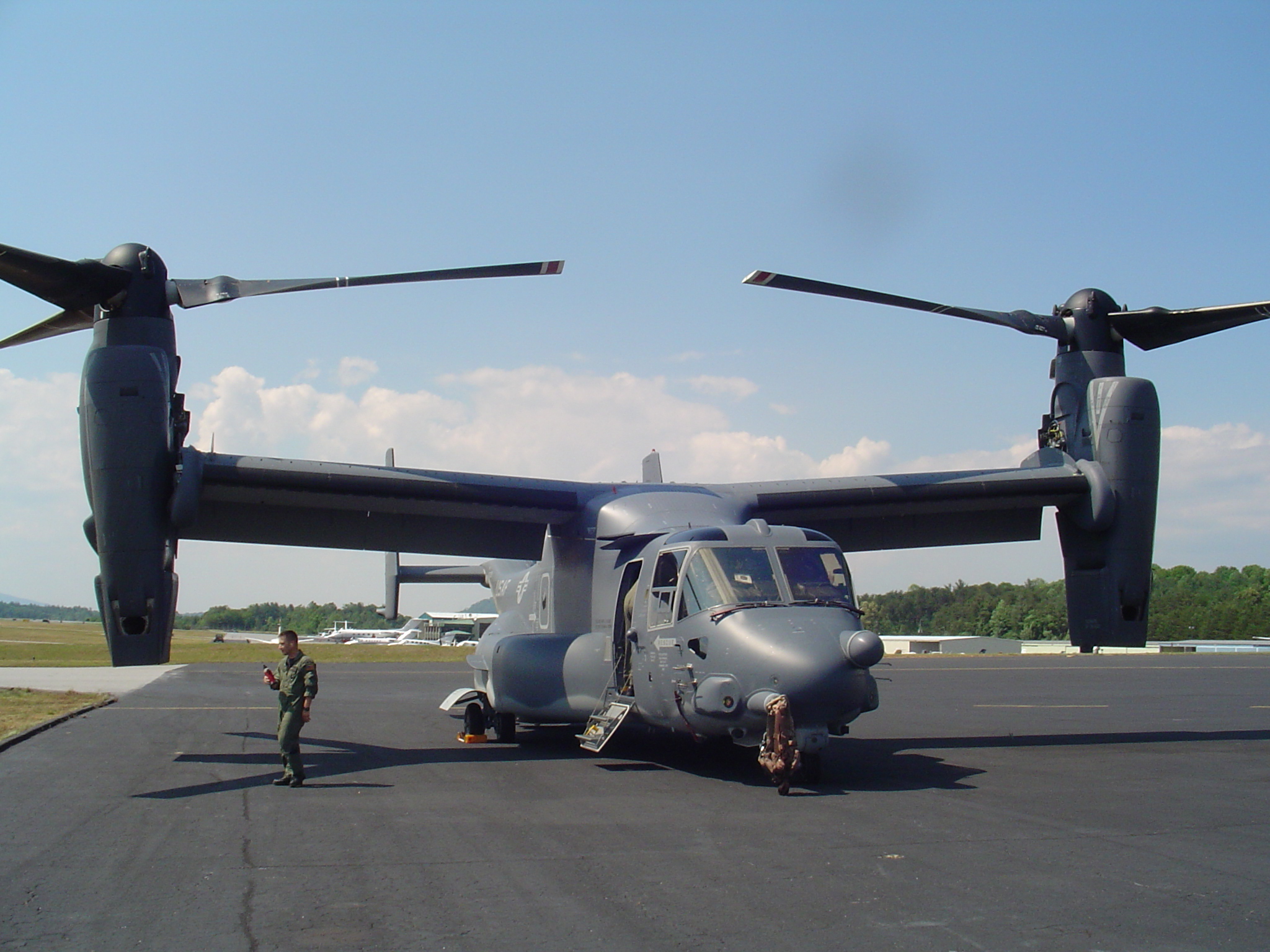
Or this:  “Was that a helicopter or an airplane I saw land at the airport today?  It didn’t look like any airplane I’ve ever seen – it had wings, but it also had propellers like a helicopter.”

Or even this:  “Can you tell me what the low-flying, small aircraft flying in formation were, and why they were here?”

If you look to the skies, on a pretty regular basis around the airport you will see many different kinds of military aircraft.  And this doesn’t make sense to many people – we don’t have any military bases in western North Carolina!

But think about this:  our military service men and women who fly military aircraft must continually train, build their hours in the air, and fly in different types of airspace and environments.  Asheville Regional Airport is a high altitude airport in the eastern U.S., located within mountainous terrain.  We are great training ground for the military.

There are several military bases located within an easy hour or two flight from AVL – from Florida to the coast of North Carolina.  We’ve even seen military aircraft here all the way from California!

So, yes, you are sometimes seeing unusual aircraft in the skies (at least unusual for our area).  However, when you call and ask us what aircraft are flying on a particular day, or where they are from – we may not be able to answer your question.  Flight plans do not have to be filed with us ahead of time, and often, when military aircraft arrive in town, we are as delighted and surprised as you are!    (Note:  The Federal Aviation Administration Control Tower is in contact with all pilots as they maneuver controlled airspace, and request to take off or land at AVL; however, the team of airport workers "on the ground" and in the terminal are not.  It is not uncommon to see employees at AVL with their noses pressed to glass, checking out the cool aircraft that have just arrived.)

Most often, the military aircraft are practicing take-offs and landings, so they land and then immediately take off again multiple times in a row.  These are called “touch and go’s” and are common training exercises.

The photo above is of a frequent visitor to our area - a Boeing V-22 Osprey, operated by the U.S. Marines and the U.S. Air Force.  We enjoy seeing these “UFO’s” when they come, and hope you do, too.

Airport sharing this news on behalf of N.C. Department of Transportation: Bridge closure at Airport Road planned this weekend

November 12, 2015

As part of their Diverging Diamond Interchange Project, the North Carolina Department of Transportation is planning a temporary bridge closure for this weekend, starting November 13, at the I-26 and Airport Road location.

Details available here.


AVL Executive Director elected as an ACI-NA governing board regional advisor

October 14, 2015

(Asheville, N.C.)  At the annual Airports Council International meeting in Long Beach, C.A. in October, Lew Bleiweis, A.A.E., executive director of Asheville Regional Airport, was elected as an Airports Council International – North America (ACI-NA) regional advisor of the ACI World Governing Board.  Bleiweis currently serves as chair of ACI-NA’s U.S. Policy Board, a role that focuses on advocacy for legislative policy decisions that affect the airport industry in the United States.  “It is an honor to be elected as a regional advisor to the World Governing Board,” said Bleiweis.  “Airports are extremely important globally, not just from a travel perspective, but from an international economic perspective, and I look forward to being involved in continuing to shape a positive future for our industry.” “Asheville Regional Airport is being led by one of the airport industry’s thought leaders,” said Bob Roberts, Chair of the Greater Asheville Regional Airport Authority Board.  “The airport has grown and thrived with Lew as our executive director, and the work he will continue to do with Airports Council International is important to the airport industry as a whole.” As the international association of the worlds’ commercial service airports, ACI represents the collective positions of its membership, which are established through committees and endorsed by the ACI Governing Board. These views reflect the common interests of the global airports community.  ACI members operate 1,751 airports in 174 countries.

Buddy the Bear: Wildlife at Airports

October 14, 2015

Our airport is located in the mountains, and as such, we share our space with the critters who call WNC home.  Early this month, we had a “critter visitor” who decided to stay a while.  We named him “Buddy.”  And he’s a black bear. Buddy climbed a tree near our parking lot one night, and hung out there for nearly four days.  You may have seen his picture on television – our friends at WLOS heard about our bear from some passengers, and gave him his fifteen minutes of fame on the evening news! What you may not know is that we take our interaction with wildlife at the airport very seriously.  We certainly want to respect our wildlife neighbors, and at the same time, deter them from coming to the airport.  Safety is our top priority, and wildlife can cause unsafe conditions at an airport – especially if they are present in the vicinity of the airfield (or in public areas, depending on the kind of animal in that area). Buddy the bear is a good example.  When we learned of his presence in the tree, we contacted state wildlife biologists to determine an appropriate plan to ensure public safety.  We were told that the bear would most likely leave on his own, so our public safety department monitored him closely.  Wildlife biologists were on alert to encourage him down from the tree and capture and release him, if needed.  Fortunately, Buddy got bored with the view (and maybe wanted a quieter place to rest), and headed home. All commercial airports are required by the Federal Aviation Administration to have wildlife management programs in place.  These programs include:  (1) daily inspections of key areas at and around the airport – in which we look for things like wildlife, signs of wildlife and habitat issues; (2) wildlife control measures, such as fencing and habitat alterations; and (3) wildlife deterrent measures, such as use of “scare rounds” and bangers, which are noise tactics used to scare birds and other wildlife away from the airfield. At Asheville Regional Airport, we work closely with the North Carolina Wildlife Resources Commission to ensure that our wildlife plan is appropriate and effective.  We train staff annually, and we inspect conditions daily.  It is our responsibility, and a part of our focus on safety.

Operation Medicine Drop will be held at Asheville Regional Airport on September 26

September 17, 2015

(Asheville, NC) In an effort to provide a safe, secure way for residents of western North Carolina to dispose of potentially dangerous expired, unused or unwanted prescription medications, Asheville Regional Airport Department of Public Safety and the Partnership for Substance Free Students in Buncombe County will host a drop-off event on Saturday, September 26 from 10a.m. to 2p.m. The region is invited to bring medications for safe disposal to the Department of Public Safety at the airport, located at 136 Wright Brothers Way, Fletcher, N.C. 28732 (parking is located in front of the building). The service is free, drop off will be quick and easy, and all drop-offs will remain anonymous. There will be no paperwork required and no questions asked. Officers will be on hand to accept the medications, which will then be gathered for safe disposal. “Prescription medications in the wrong hands – especially in the hands of our area’s young people or improperly disposed of in the environment – can be dangerous,” said Kevan Smith, Public Safety Chief at Asheville Regional Airport. “Part of our job as public safety officers is to partner with our regional agencies to make our area as safe as possible, and we are pleased to be able to participate in this important initiative.” Operation Medicine Drop is a state-wide program held in conjunction with the U.S. Drug Enforcement Agency’s 10th Annual “Take Back” initiative. It is a coordinated effort by the North Carolina Department of Insurance, Safe Kids North Carolina, the Drug Enforcement Administration, the State Bureau of Investigation, Riverkeepers of North Carolina and local groups to prevent accidental poisonings, substance abuse and to protect our waters. The drop-off event at the airport is one of several being offered in the region. For a complete list of events, visit www.ncsafekids.org. For more information, contact the Asheville Regional Airport Department of Public Safety at (828) 684-4577, or email pr@flyavl.com.

Why should I arrive two hours before my flight? I’ve always zipped right through security at AVL!

September 17, 2015

If you’ve flown recently, you may have experienced what so many AVL travelers have experienced for years:  you quickly parked, zipped through check-in and walked right up to the security screener – no line to speak of.  You may have made it to your gate just minutes after you parked your car, plopped into a rocking chair and sent your spouse to pick up a latte at the Blue Ridge Tavern.  Nice! Yes, this experience does exist.  Conversely, though, some travelers’ arrivals at the airport go something like this: “Oh, my goodness!  Where am I going to park?  There are no spots right up front.  The lot is really full…  Where are all of these people going?” Fifteen minutes later – after parking and walking to the terminal: “Oh, geez.  Look at that ticket counter line!  Good thing I checked in on-line.  I’m heading straight to security…. Uh-oh.  That IS the security line – all the way back here near the ticket counters.  Oh, no.  My flight leaves in thirty minutes.  I hope this line moves quickly.  Where ARE all of these people going?” Five minutes later: “How many people are ahead?  Gosh – looks like there are about fifty people up there.” Five minutes later (frustration is building): “Can this line move faster?  Come ON, people.  Get those shoes off, pull out your laptop – get it ready for the bin…  Move, move, move!” Five minutes later: “Come on, come on, come on…  I’ve got a plane to catch!  I hope they hold the plane for me.” (editorial note:  Airlines will NOT hold the plane.) Five minutes later: “Ok.  Getting closer – I might make it." Five minutes later: “Alright.  Shoes and jacket in the bin.  Laptop in its own bin.  Liquids in my clear, zip-top bag in the bin.  Let’s go, let’s go, let’s go…  I’ve got to board my plane.” Five minutes later: This traveler arrives at the gate and is the last to board her flight.  She just made it.  How does she feel?  Relieved?  Stressed?  Frustrated?  Angry? In this situation, this traveler (let’s call her “Lisa Latecomer”) allowed barely enough time to go through all the steps necessary to travel by air.  If you count the minutes – from arrival and parking to boarding her plane, the process took about 45 minutes (not bad, really – a reasonable amount of time).  BUT – she almost didn’t make it.  What if those in the security line ahead of her were much slower about preparing themselves for screening?  What if even more travelers had arrived at the same time to go through screening?  (The line could have been longer.) There are a few things happening at AVL that travelers should be aware of:

  1. More and more travelers are using the airport.  In fact, the airport has served a record number of passengers in the past 12 months (which is great news for the airport, our region … and hey, thank you, travelers, for “flying local”!)
  2. Airlines are using larger planes.  That means more people arrive at the airport at one time to check-in for their flights.  Hundreds more, sometimes, depending on flight schedules.
  3. The Transportation Security Administration (TSA) has adjusted staffing during peak travel times to screen the larger number of travelers as efficiently as possible.  Even with two security lines operating, only so many passengers can be screened each hour, so when lines are long, waits will happen.
  4. The TSA recently added a body scanner at AVL.  This technology improves efficiency of security screening.
  5. While TSA has not implemented a Pre Check line at AVL (this must be approved by the national Department of Homeland Security), if you are a registered Pre Check traveler, you will not have to remove your shoes, jacket or belt at AVL, which should help expedite the process.

We also know that now more than ever, there are many travelers boarding a plane for the first time – or the first time in many years – and they may not understand their role in the screening process.  These inexperienced fliers may not know that they have to remove their shoes and jackets, pull their liquids from their carryon bag to place in the bin, or other requirements.  And… please know we say this with understanding and kindness… these travelers can definitely slow the security screening process. So – we’ve decided to help educate them.  Watch for fun signage at the airport that we hope grabs the attention of our travelers, and helps them prepare for screening while they are in line so when it’s time to be screened, the bins are ready quickly and the line moves more efficiently. Will you have to wait in a line the next time you fly from AVL?  Perhaps.  There are definitely still times when you’ll zip right in with lots of time to spare.  But you can’t count on it. Instead, come to the airport early (we recommend two hours before your boarding time).  Avoid the frustration and angst created by cutting it too close.  Chances are you’ll enjoy our rocking chairs, our great food (and local beer and wine, too), the view of the runway and mountains, our free wifi, and you can even get a little work done in our quiet business center. And when you board your plane, you’ll be relaxed and ready to start your trip.

Introducing our new website!

July 30, 2015

We know you, AVL website visitor.  We know that when you visit our airport website, you come with a utilitarian purpose.  Usually – you are here to check the status of a flight.  Is the arrival or departure still on time?  If not, how delayed will the plane be? We also know that you often play with a fun gizmo on our website called “Flight Tracker” – you know, it’s the map that shows where the airplanes are located in real time. You sometimes access our Frequently Asked Questions, or check flight schedules or rates for flights at our booking site. Yes, these are the most frequently accessed areas of our website – and now they look refreshed, brighter, and redesigned. Our new website has all the information you are accustomed to accessing, but we’ve also added to it in ways that we hope enhance your experience with AVL.  We invite you to take a look!   The Social Hub We’ve added a Social Hub. (Get it?  “Hub?” Aviation terminology…) When you click on “Social Hub” (found in the main menu), you will be taken to an interactive area of the site where you can get “social” with us.  Take a look!  We’re on Facebook, Instagram, Twitter, Pinterest and YouTube.  We always have some kind of contest in the works – we love to give away AVL gear, gift cards to local restaurants and stores, and sometimes even airline tickets!  You never know what kind of crazy fun we’ll have up our sleeves. The Social Hub is also where you’ll find information about art and music in the airport.  The artistic vibe of western North Carolina is such a huge part of the local culture, and we are always looking for ways to include a piece of that culture in the airport for passengers and visitors to enjoy.  Artists and musicians in our area are invited to become a part of our Art+Music in the Airport program. You can also “Make Your Connection” (again, aviation terminology intended!).  We invite you to share your feedback, take our survey or join our loyalty program.   Community Connection A new page on our website highlights different ways your local airport connects with the community.  We are a big part of western North Carolina, and take our role as an economic anchor organization seriously.  We partner with numerous economic development organizations, as well as Chambers of Commerce.  We engage with local aviation organizations, and also sponsor events that allow us to reach our regional travelers with information about the airport.   The Easy Way.  That’s us. With our website redesign, our goal was to make the information you need easy to find and easy to read – and all design choices were made with this in mind.  We’ve also incorporated design elements that provide color contrast, meta descriptions and font choices that make navigation of our site easier for visually impaired visitors. Additionally, this new site is a “responsive” website.  That means the content will change its look and orientation for easy viewing depending upon the device used to access the site (desktop, laptop, mobile phone, tablet).  The size of the screen and its orientation (landscape or portrait) will determine the layout you see.  The most robust and full view of the website will always be on a computer screen. Thanks for taking a minute to visit our new site.  We hope you’ll connect with us, too.  And, as always, thank you for checking AVL first when planning your next trip!

Pagination

  • First page « First
  • Previous page ‹ Previous
  • …
  • Page 16
  • Page 17
  • Page 18
  • Page 19
  • Current page 20
  • Page 21
  • Page 22
  • Page 23
  • Page 24
  • …
  • Next page Next ›
  • Last page Last »
Home

Greater Asheville Regional Airport Authority 61 Terminal Drive, Suite 1 Fletcher, NC 28732

828-684-2226

828-684-3404

pr@flyavl.com

© 2025 Asheville Regional Airport.
Development Partner: Bitcookie

2025 Redesign Footer Menu

  • Passengers
    • Book a Trip
    • Parking + Transportation
    • In the Terminal
    • Arrivals
    • Departures
    • Flight Tracker
  • Business
    • Airport Authority
    • Planning + Development
    • Doing Business with AVL
    • Tenants
    • Board Documents
    • Internal Resources
  • More
    • Special Needs
    • News + Statistics
    • Career Opportunities
    • Report Lost Item
    • Sign Up — Window Seat E-newsletter
    • Contact Us