x
Passengers
Business
Workforce

Main navigation

  • Flights
    • Book a Trip
    • Arrivals
    • Departures
    • Flight Tracker
  • Parking + Transportation
    • Parking
    • Rental Cars
    • Ground Transportation
  • Passenger Services
    • In the Terminal
    • Safety + Operations
    • Special Needs
    • Passenger Appreciation
  • FAQs
    • About the Airport
    • Flights + Airlines
    • Passenger Services
    • Travel Tips
    • Security
  • News + Statistics
    • News
    • Statistics
    • Media
    • News Archives
  • Community Connection
    • Art + Music in the Airport
    • Honoring Western North Carolina Pilots
    • Make a Suggestion
  • General Aviation
    • General Info
    • Directions
    • Maintenance + Sales
    • Fixed-Base Operator
    • Learn to Fly
    • For Pilots
  • Sign Up — Window Seat E-newsletter
  • Contact Us

Business Menu

  • Airport Authority
    • Annual Report
    • Rules + Regulations
    • History
    • Tenants
    • Ordinances
    • Staff
    • Career Opportunities
  • Doing Business with AVL
    • Advertising
    • Filming on Site
    • DBE/ACDBE Programs
    • RFP-RFQ-RFB
    • AVL Minimum Standards
    • Airport Development Guidelines
  • Planning + Development
    • 2013 MASTER PLAN DOCUMENTS
    • CURRENT MASTER PLAN PROCESS
  • Board
    • Board Documents
    • Board Schedule + Legal Notices
    • Action Agenda
    • Board Agenda
    • Budget
    • Meeting Minutes

Workforce Menu

  • AVL KIND
X        
mobile navbar button
Home

Breadcrumb

  1. Home
  2. News + Statistics
News

News

Stay updated with AVL Airport’s latest news, including announcements, travel tips, and important airport developments. Explore recent stories and insights to make the most of your travel experience and stay informed about what’s happening at AVL.

Swoosh

Reimagined: Local artists highlighted in airport art gallery

May 9, 2016

Postcard_REIMAGINED

(Asheville, N.C.) Asheville Regional Airport (AVL) has a new Art in the Airport exhibit on display. The exhibit is called Reimagined and is open through September 4, 2016. This exhibit highlights the work of local artists using a number of distinct styles and mediums.

A walk through the airport gallery calls you to reimagine or rethink the way you see what is on the canvas. The lines, colors, and forms can take on a new life. From metal to wood and photography to pastels, the vivid art forms have arrived just in time for the summer travel season.

The five local artists that can be seen in the gallery are Carol L. MacAllister, Robert Mahosky, Hartley Meinzer, Wendy Newman, and Elise Okrend. 

"The art gallery is truly a way for both the passengers and public alike to experience a taste of our region," said Alexandra Bradley, Marketing and Public Relations Specialist at AVL and curator of the gallery. 


Artwork can be purchased from the gallery by emailing art@flyavl.com. Artists who reside in any of the eleven counties within AVL's primary service market may apply for acceptance into upcoming exhibits. Details about the program, including application instructions, can be found on the airport's website at flyavl.com and click on ART + MUSIC.


# # # # #

What’s the Difference: Regional vs. Network Airlines

April 20, 2016

“Welcome aboard flight 5429, operated by PSA airlines, we’re happy to have you with us today.” Whether a road warrior or an infrequent traveler, odds are you’ve heard an announcement just like this. Why is your flight being flown by an unfamiliar airline? For decades, network airlines (you know, very familiar airlines like American, Delta and United) have used regional airlines with smaller aircraft to feed their hubs from smaller cities and to serve routes that aren’t large enough for a mainline jet.

Regional airlines generally fly aircraft between 50 and 76 seats, while most mainline airlines fly aircraft with 100 seats or more. Because the aircraft have so few seats, the cost for mainline (network) airlines to operate them could make them uneconomical. Regional airlines instead operate these planes at costs that are more economical to fly. They generally don’t have some of the expenses that mainline carriers incur by virtue of flying larger aircraft. For example, ExpressJet doesn’t own any hangars that can house a 747, nor do they have the tools to work on massive 777 engines. Pilots and flight attendants generally start their careers at regional carriers and move up to mainline as openings become available. Regional airline flight crews and mechanics go through all of the same rigorous training as the mainline carriers.  Some regional airlines are actually wholly-owned subsidiaries of the mainline carrier.

There are nearly 30 regional airlines in the United States. Smaller airplanes don’t necessarily mean smaller businesses. Some, like SkyWest and ExpressJet, are actually larger and have more aircraft than many airlines that fly larger planes. There are many ways their contracts to fly are negotiated, but in a nutshell, the mainline airlines like Delta pay regional airlines like ExpressJet to operate flights on their behalf. The way the regional airline gets paid by the mainline carrier is subject to the contract between the two airlines, which is often broken down into groups of aircraft. A regional carrier with 30 planes can have 3 sets of 10 planes, with each set operating under a different contract for the same mainline carrier.

The most noticeable difference to the passenger between a regional airline and a mainline airline is the size of the aircraft. In most cases, everything else will be the same: The aircraft will be painted in the mainline airline’s colors and will fly routes for that airline as if it were one of their own. The mainline carriers want passengers to experience the same product benefits on their regionals as they do on their mainline flights. There are now more regional jets with features like first class and Wi-Fi than there have ever been and the number continues to grow.

Without regional airlines, there would be hundreds (yes, hundreds) of cities that simply wouldn’t have air service. Smaller aircraft allow the airlines to fly to smaller cities and to have added schedule flexibility. Regional airlines have been an integral part of the air transportation network for decades and will continue to serve smaller cities well into the future.

Student Artwork Showcase - WNC students (K-12) exhibit work at airport gallery

March 29, 2016

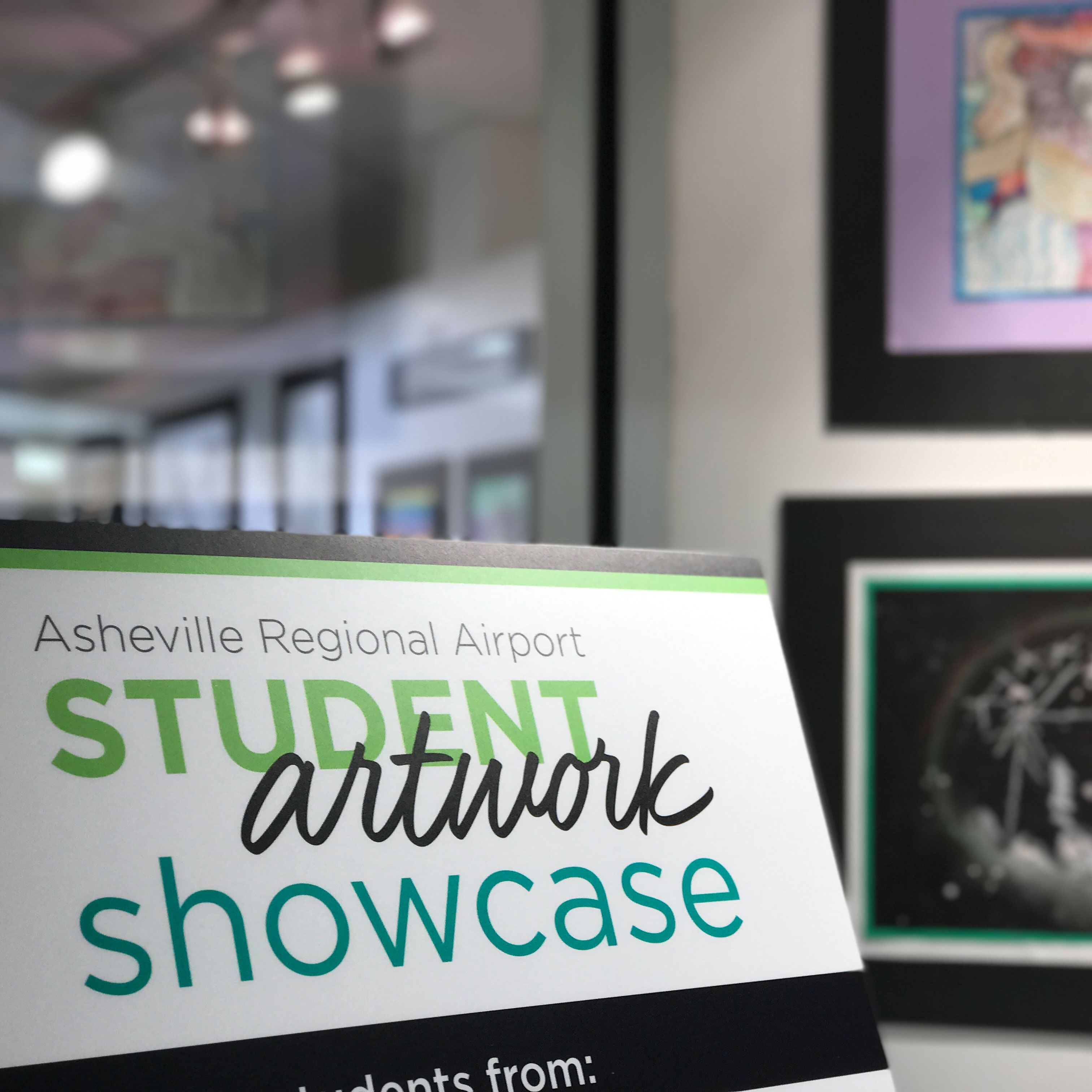
(Asheville, N.C.) The Student Artwork Showcase, the newest exhibit at the Asheville Regional Airport Art Gallery, is on display until May 1, 2016. This showcase highlights the creativity of students across our region. This exhibit displays a variety of mediums and techniques by students attending Carolina Day School, ranging from grades kindergarten to twelfth grade. 

The bold uses of color in many of the pieces are highly contrasted by the traditional black and white still film photography on display. The students' work varies in medium, from pen and ink, pottery, painting, to paper collage. Overall, the showcase is a bright escape into a creative point of view.

"The art gallery is truly a way for both the passengers and public alike to experience a taste of our region," said Alexandra Bradley, Marketing and Public Relations Specialist at AVL and curator of the gallery. 

Asheville Regional Airport's Art in the Airport program is pleased to feature an annual Student Artwork Showcase in our Art Gallery, highlighting the creativity of students across our region. If your school would like to participate in the Student Artwork Showcase, please visit flyavl.com and click on Art + Music in the Social Hub to learn more.


# # # # #


What is Leakage? Why is it important?

March 24, 2016

Leakage is an air service development term.  We thought we’d help educate you about why it’s important.

Let's talk leakage. Surely everyone is familiar with leaks of some kind. We've all had a leaky faucet or a flat tire. Leakage, as most know it, is something escaping from where it should be confined. Whether the thought of a leak makes you think of water, air, or something else, the general concept is likely the same. In the airport world, leakage is what occurs when passengers from one airport's core market drive to another airport to catch a flight. 

In the vast majority of leakage situations, passengers from smaller cities drive to larger cities to fly. This can happen for many reasons. Some drive to the larger airport to catch a nonstop flight, as opposed to a connecting flight from their hometown. Others may hit the road as the result of a lower fare to their final destination. Ironically, many people who drive hours to save money on their fare may or may not save any money at all after adding up the value of time spent, gas, and other expenses associated with traveling to a farther away airport.

Why should you care about leakage? What’s the big deal? Thinking locally, the Asheville Regional Airport leaks passengers primarily to Charlotte and, to a lesser degree Greenville and Atlanta. While our flight options and passenger numbers continue to grow, there still exists a fair number of people who opt to fly from another airport. When someone who lives closer to Asheville drives to Charlotte to fly, they’re actually contributing to the reason they chose to drive in the first place.

Let us explain.


As more people fly from our local airport, the airlines add bigger planes and flights to new places; each of which tends to lower fares over time (think supply and demand). This also increases opportunities for visitors and business travelers from other places to come to our region and spend money. The money you spend on your ticket ultimately puts more money into the local economy. Leaving the area to fly has the opposite effect. Fewer passengers leads to fewer planes, fewer destinations and higher fares… it’s a vicious cycle!  Right now, AVL is in a position in which airlines are offering excellent connectivity, more seats on larger planes, and yes, the planes are pretty full.  The region’s air travelers are using AVL more than ever before, which is great news!


We hope this information helps you understand why we ask our region to “check AVL first.”  The next time you’re about to book a flight from another airport, think about how much you’ll actually be saving and if your time is worth it. Of course, if you’re saving hundreds we don’t blame you. But if the savings isn’t that great to fly from an airport that’s two-hours away, it’s probably worth thinking twice about that 4 hours in the car — for you, and for your local economy! 

Let’s Talk Drones

February 23, 2016

By now, almost all of us have heard about drones – you know, unmanned aircraft. You might’ve seen a news story about them, heard of their military use, or seen some teenagers flying one in the park. The FAA recently announced that the number of registered drones has surpassed the number of registered airplanes in the United States. As the many uses of drones evolve, it’s becoming increasingly apparent that they’ll be in the skies for quite some time. While they may be small in size, these remote controlled flying machines have been causing quite the stir.

What exactly is a drone? In laymen’s terms, a drone is any unmanned flying machine that can be controlled remotely or with the aid of an onboard computer. Depending on who’s talking about them, you might also hear a drone referred to as a quadcopter, a “UAV” (unmanned aerial vehicle) or UAS (unmanned aerial system). Most civilian drones are relatively small—no more than a few feet in diameter and less than 50lbs. Some commercial and military models, however, have wingspans of up to 55 feet, feature jet engines, and can fly over 12,000 miles. Drones have been around for over a decade, but their popularity has skyrocketed in recent years with estimates of over 2 million units sold in 2015, up from roughly 300,000 in 2013.

As drone numbers continue to grow, so do their various uses. It’s not uncommon to see drones used for aerial photography, surveying and even search and rescue. Some companies like Amazon are even seeking approval to use them for urban package delivery. Add in the number of recreational users zipping them through the skies for sheer enjoyment, and it’s easy to see how the drone population is soaring. They’ve proven to be great assets to many companies and allow many jobs to be completed faster, cheaper, and safer than ever before. Any enthusiast will tell you that drones are a blast to fly and some of their autopilot abilities certainly give them a “cool” factor. More than 325,000 people have now registered drones.

There are so many drones flying that ensuring they safely share the skies with airplanes has become a focus of the FAA. At any given moment during the day, there are roughly 7,000 airplanes flying in U.S. airspace, along with an increasing number of drones. Every month in our nation, there have been roughly 100 pilot reports of drones flying in close proximity to their aircraft. These situations generally happen when a drone is being flown too close to the approach or departure paths of an airport. That said, there have been zero collisions between drones and aircraft. There are FAA guidelines for drone or model aircraft operations that exist to prevent such instances and the FAA continues to adapt their regulations to ensure that drones and aircraft share the skies safely.

If you own a drone or are looking into purchasing one, the FAA website provides everything you need to know to safely operate your aircraft. As of December 2015, all drones between .55lbs and 55lbs must be registered online with the FAA before flying them outdoors. Drones over 55lbs must go through the standard aircraft registration process, just like an airplane. Any U.S. citizen over the age of thirteen can register a drone and the FAA even has an online chart for helping you determine whether or not your drone needs registered. Registration is just one of what will likely be many steps taken by the FAA to help drone users safely share the skies with aircraft.


Some of the most commonly communicated safety rules include:

Never fly above 400 feet (measured from ground level)

Always fly within your visual line of sight

Do not fly within 5 miles of an airport

Do not fly above stadiums or public events


Additional rules apply to commercially operated UAS, and it is the operator’s responsibility to be educated and in compliance.

Lastly, while the FAA is working hard to define its regulations regarding drones, it is very important for drone owners to understand that there are state and local laws pertaining to operation of drones, as well.  The North Carolina Department of Transportation Aviation Division is ahead of the curve in its efforts to educate UAS owners and operators, and they offer a robust on-line program that educates about how to legally operate drones in North Carolina.  Learn more here.

Large and small, fast and slow, drones are here to stay.  Do your part and familiarize yourself with all you need to know to operate your drone legally and safely.


Sources:

https://www.faa.gov/uas/

https://www.washingtonpost.com/world/national-security/federal-regulators-to-require-registration-of-recreational-drones/2015/10/19/434961be-7664-11e5-a958-d889faf561dc_story.html

AVL announces another record year of passenger service

February 22, 2016

(Fletcher, N.C.)  Asheville Regional Airport (AVL) served a record number of passengers in calendar year 2015:  392,713 passengers enplaned at the airport in 2015, and 394,324 passengers deplaned, which is an overall 4% increase compared to 2014, the previous record year of passengers served.

The air service offerings at AVL have changed in the past few years.  The airport continues to be served with a strong number of frequent daily flights to major hubs offered by legacy airlines American, Delta and United.  At the same time, Ultra Low-Cost Carrier (ULCC) Allegiant Air has continued to grow its presence in the market.  In 2015, Allegiant added its fifth non-stop destination (Palm Beach International Airport), and designated AVL as a hub of operations, basing two aircraft, crews and a maintenance facility at the airport.

“We have a robust compliment of air service at Asheville Regional Airport provided by our four excellent airline partners,” said Lew Bleiweis, A.A.E., Executive Director.  “Simultaneously, our region uses AVL, which perpetuates the strength of the air service in our region.”

AVL was identified as the best connected non-hub airport in America in 2013 by MIT's International Center for Air Transportation, and has enjoyed continued growth since that time, now classified by the Federal Aviation Administration as a small-hub airport. Seats in the market have been strong, and a look ahead shows continued growth on the horizon, beginning with Allegiant’s new non-stop service to Baltimore/Washington International Thurgood Marshall Airport in May.

# # # # #

From Legacy to Low Cost: How Different Types of Airlines Work

January 27, 2016

Do you ever wonder why some airlines' tickets cost so much less than others, or why some charge more for baggage and seat selection? Every business in every industry is a little different than its competitors and airlines are no exception. Within aviation, airlines are generally grouped into three categories: legacy (or “network”) airlines, low cost carriers (LCCs), and ultra low cost carriers (ULCCs). While no two airlines are exactly alike, almost all of them fall into one of these categories.

Ultra low cost airlines like Allegiant, Spirit and  Frontier have the goal of offering the lowest ticket price possible. Their tickets can be described as “no frills” and things like bags, seat selection, and onboard food and drinks generally cost extra. They are extremely cost-responsible in their operations and management, which allows them to offer the lowest airfares. By not including the cost of a bag, snacks, drinks, in-flight entertainment, and other amenities in the ticket price, these airlines can often offer extremely low fares and high value. ULCC’s generally cater to people going on vacation or enjoying other forms of leisure travel, but each one does so differently. Frontier and Spirit almost exclusively fly between very large markets, with at least one roundtrip flight per day, and they don’t mind adding routes that other airlines already fly. Allegiant’s core model is to fly from small- or mid-sized communities (just like us) to very popular leisure destinations a few times per week. Many consider this a relatively new airline business model, but it’s more or less a refining of the low cost carrier model that some airlines have been using since the 1970s.

When we say “low cost carrier” the first airline that pops into your mind could very well be Southwest Airlines, as they’ve been flying since 1971 and touting low fares and friendly service as they’ve grown into the nation’s largest domestic airline in terms of the number of passengers carried. These days, however, the LCC category has become a bit less defined than it once was. The term actually has more to do with an airline’s operating costs than with its ticket prices, which are simply a result of the low operating costs. Frontier and Spirit were once LCCs but transitioned to become ULCCs. Other airlines in this category like JetBlue and Virgin America are regarded as low cost carriers by some and not by others. Some would say that the traditional LCC’s like Southwest and JetBlue have slowly transformed into carriers whose fares aren’t always “low” but are never “high” and include some amenities in their ticket price. As these airlines have matured, they’ve grown into having large networks with far more connecting traffic and have added passenger comforts like in-flight entertainment, which raises the cost to operate.

Last but not least, the network airlines are the mega-brands that have been around in one form or another since the dawn of commercial aviation. American, Delta, and United are the three U.S. network airlines. These are the most “evolved” airlines and have global route networks, huge hubs, huge fleets and multiple types of aircraft. With aircraft ranging from 50 to nearly 400 seats, network airlines can get you from Asheville to Shanghai, often in just one stop. They carry a wide array of passengers, including leisure and business passengers traveling domestically or internationally.  They have sophisticated products that cater to business and international travelers. First-class cabins, club lounges, in-flight entertainment and Wi-Fi have become core products for this group of airlines. They’ll happily connect you to Florida for vacation, as well as London or Boston on a last-minute business venture.

As the industry and the consumer both continue to evolve, so do the airlines. Throughout history, airlines of all types and sizes have come, grown, evolved, changed and gone. Once mighty legacy airlines like Pan Am have gone under and others like Piedmont have become part of the lineage of today’s airlines through mergers. The only constant is that regardless of your budget and destination, there will almost always be an airline built to cater to you.


A runway is important to Western North Carolina! Take a journey with us to learn why.

December 17, 2015

They say a mile of highway will take you a mile but a mile of runway will take you anywhere. When your plane takes the runway at Asheville Regional Airport, takeoff thrust is applied and after approximately one mile of acceleration, you gracefully begin to soar airborne. You didn’t just depart for Atlanta, Charlotte, Florida, New York or Chicago. You just entered the vast, global air transportation network. You could be headed to the other side of the state or the other end of the globe.

At a glance, a runway may appear to only be pavement with different colored lights and paint, but a runway is the greatest gateway to the world a community can possess, and a massive economic engine as well (to the tune of half a billion dollars in this case). At AVL, our runway allows our community to do business all over the world. It allows residents of Asheville and western North Carolina to easily venture to any point on the planet they please. Like a highway, a runway is also omnidirectional, both physically and figuratively. That same runway that lets you jet off to London for business or glide into Palm Beach for vacation also allows business travelers and visitors from far away places to come to our community. It lets them invest in our region — our families, businesses and quality of life — by bringing their own business here, visiting WNC to shop or sight-see and to experience this amazing region we call home.

It’s for all of these reasons that the runway at AVL is worthy of our care and attention. Right now, we’re in the third of four construction phases that will result in a brand new runway, which translates to new opportunities for WNC. Starting this month and continuing over the next year, you’ll be able to see the construction of the new runway here at AVL as your flights take off and land on a temporary runway that is serving as a literal stepping stone to the future.

Near the end of 2017, you will board a jet at Asheville Regional Airport. When your plane crosses the threshold of the runway and takeoff thrust is applied, you will accelerate down the smooth pavement, passing lights and runway markers, knowing that this mile of runway is taking our community higher and is giving you the power to go anywhere.

Please take a moment to learn more about our important runway project, titled "Project SOAR."

Of The Essence: Local artists exhibiting in airport art gallery

November 20, 2015

(Asheville, N.C.) Of The Essence, the newest Art in the Airport exhibit at Asheville Regional Airport (AVL) is now open through March 7, 2016. This exhibit showcases fine art pieces in a variety of mediums, from silk and paper to hardwoods. The paintings' vibrant colors imbue an essence of the season, while intricately crafted hardwood clocks create an essence of reflection.   As viewers observe the gallery, they are invited to take a moment in "time" to enjoy the season.

Three, western North Carolina based artists, Lisa De Girolamo, Kathy Goodson, and Connie Molland, are featured in the Of The Essence exhibit. Onlookers are able to see a variety of styles and methods used by the artists, as they tour the gallery.

"The art gallery is truly a way for both the passengers and public alike to experience a taste of our region," said Alexandra Bradley, Marketing and Public Relations Specialist at AVL and curator of the gallery.

Artwork can be purchased from the gallery by emailing art@flyavl.com. Artists who reside in any of the eleven counties within AVL's primary service market may apply for acceptance into upcoming exhibits. Details about the program, including application instructions, can be found on the airport's website at flyavl.com.


What is that Unidentified Flying Object coming in for a landing at AVL?

November 19, 2015

DSC00888

At Asheville Regional Airport, we sometimes receive phone calls or emails that sound something like this:  “I saw a large, unmarked white … plane, I think … flying really low around the airport.  It made a loud rumbling sound, and it seems to be circling.  What is it, and why is it here?”

Or this:  “Was that a helicopter or an airplane I saw land at the airport today?  It didn’t look like any airplane I’ve ever seen – it had wings, but it also had propellers like a helicopter.”

Or even this:  “Can you tell me what the low-flying, small aircraft flying in formation were, and why they were here?”

If you look to the skies, on a pretty regular basis around the airport you will see many different kinds of military aircraft.  And this doesn’t make sense to many people – we don’t have any military bases in western North Carolina!

But think about this:  our military service men and women who fly military aircraft must continually train, build their hours in the air, and fly in different types of airspace and environments.  Asheville Regional Airport is a high altitude airport in the eastern U.S., located within mountainous terrain.  We are great training ground for the military.

There are several military bases located within an easy hour or two flight from AVL – from Florida to the coast of North Carolina.  We’ve even seen military aircraft here all the way from California!

So, yes, you are sometimes seeing unusual aircraft in the skies (at least unusual for our area).  However, when you call and ask us what aircraft are flying on a particular day, or where they are from – we may not be able to answer your question.  Flight plans do not have to be filed with us ahead of time, and often, when military aircraft arrive in town, we are as delighted and surprised as you are!    (Note:  The Federal Aviation Administration Control Tower is in contact with all pilots as they maneuver controlled airspace, and request to take off or land at AVL; however, the team of airport workers "on the ground" and in the terminal are not.  It is not uncommon to see employees at AVL with their noses pressed to glass, checking out the cool aircraft that have just arrived.)

Most often, the military aircraft are practicing take-offs and landings, so they land and then immediately take off again multiple times in a row.  These are called “touch and go’s” and are common training exercises.

The photo above is of a frequent visitor to our area - a Boeing V-22 Osprey, operated by the U.S. Marines and the U.S. Air Force.  We enjoy seeing these “UFO’s” when they come, and hope you do, too.

Pagination

  • First page « First
  • Previous page ‹ Previous
  • …
  • Page 15
  • Page 16
  • Page 17
  • Page 18
  • Current page 19
  • Page 20
  • Page 21
  • Page 22
  • Page 23
  • …
  • Next page Next ›
  • Last page Last »

Recent News

Asheville Regional Airport’s Tina Kinsey Honored with International Ted Bushelman Legacy Award for Creativity and Excellence
Asheville Regional Airport Earns Top Honors at 2025 ACI-NA MARCOM Awards
Grayson Manning: Painting Light into Darkness
Davis Perrott: Sculpting the Collision of Worlds
Sandra Bottinelli: Creating Her Own Path
View Archives
Home

Greater Asheville Regional Airport Authority 61 Terminal Drive, Suite 1 Fletcher, NC 28732

828-684-2226

828-684-3404

pr@flyavl.com

© 2025 Asheville Regional Airport.
Development Partner: Bitcookie

2025 Redesign Footer Menu

  • Passengers
    • Book a Trip
    • Parking + Transportation
    • In the Terminal
    • Arrivals
    • Departures
    • Flight Tracker
  • Business
    • Airport Authority
    • Planning + Development
    • Doing Business with AVL
    • Tenants
    • Board Documents
    • Internal Resources
  • More
    • Special Needs
    • News + Statistics
    • Career Opportunities
    • Report Lost Item
    • Sign Up — Window Seat E-newsletter
    • Contact Us